 Free apartment search for tenants — no agency fees, ever
 info@visreal.vn
 Zalo
 WhatsApp


In short: Ho Chi Minh City suits expats who want the country’s largest economy, warm weather all year and a wide choice of furnished apartments. Hanoi suits those who prefer four seasons, a capital city with deep history and, on public data, lower central rents. In Visreal’s own HCMC listings, a 2-bedroom has a median asking rent of $1,300 in District 1 and $1,100 in Thao Dien.
We are an HCMC agency, so the HCMC rents below come from our own listings. For Hanoi, we rely on public sources and say so.
Hanoi vs Ho Chi Minh City at a glance
The two cities are about a two-hour flight apart, and the route between them is one of the busiest domestic air routes in the world. Many expats know both before they choose.
| Hanoi | Ho Chi Minh City | |
|---|---|---|
| Role | Capital and political centre | Largest economy and financial centre |
| Climate | Four seasons, cool dry winter | Warm all year, rainy and dry seasons |
| Temperature | Coolest month averages around 16°C | About 28°C on average, all year |
| Air quality | Worst of Vietnam’s big cities, especially in the cooler months | Lower fine-dust levels than Hanoi in IQAir data |
| Metro | Line 2A (2021) and the above-ground part of Line 3 (2024) | Line 1, Ben Thanh to Suoi Tien (2024) |
| Main expat areas | Tay Ho, Ba Dinh, Cau Giay | Thao Dien, District 1, Binh Thanh, Thu Thiem |
| Central rent | Lower on public cost-of-living data | Higher in the centre, similar further out |
One naming note: Vietnam abolished district-level government on 1 July 2025, and the enlarged HCMC now includes the former Binh Duong and Ba Ria-Vung Tau provinces. Renters and agents in both cities still use the old district names, so we do too.

Rent: what an apartment costs in each city
Across the 405 District 1, 939 Binh Thanh, 690 Thao Dien, 249 Thu Thiem and 69 District 4 listings on Visreal, median asking rents per month look like this. The figure in brackets is the middle half of listings in that area.
| Area (HCMC) | Rental market | 1-bedroom | 2-bedroom | 3-bedroom |
|---|---|---|---|---|
| District 1 | 405 listings | $950 ($850 – $1,259) | $1,300 ($1,160 – $1,545) | $2,030 ($1,604 – $2,604) |
| Binh Thanh | 939 listings | $900 ($850 – $950) | $1,380 ($1,050 – $1,550) | $1,890 ($1,450 – $2,300) |
| Thao Dien | 690 listings | $920 ($866 – $1,000) | $1,100 ($885 – $1,380) | $1,990 ($1,458 – $2,600) |
| Thu Thiem | 249 listings | $1,145 ($1,033 – $1,250) | $1,595 ($1,360 – $1,900) | $2,760 ($2,325 – $3,385) |
| District 4 | 69 listings | $825 (only 4 listings) | $950 ($900 – $1,038) | $1,100 ($1,000 – $1,350) |
These are asking rents for furnished apartments listed with us, not signed contracts. On a 12-month lease, there is often room to negotiate 5–10%.

For Hanoi, we have no listings of our own, so we will not quote a dollar figure. Two crowd-sourced cost-of-living databases, Numbeo and CityCost, both show a 1-bedroom in the city centre costing roughly half as much again in HCMC as in Hanoi. Outside the centre, the two cities are within a few percent of each other.
Those databases average all kinds of local housing, not only expat-standard furnished units. Treat them as a sign of direction, and check current Hanoi listings before you budget.
Everyday costs beyond rent are close. Numbeo puts HCMC only about 2% above Hanoi once rent is left out, with restaurant meals and coffee priced almost the same.
Where expats live in each city
In Hanoi, most foreign residents look first at Tay Ho, the area around West Lake. Expat guides describe it as the city’s most popular district with foreigners, with international restaurants, cafés and gyms, and the Quang Ba area is known as a gathering place for Western workers and diplomats.
Ba Dinh is Vietnam’s political centre, where most government offices and embassies sit. It feels more formal and local than Tay Ho. Cau Giay, to the west, is a newer district of apartment blocks and shopping malls that has urbanised quickly since the 2000s.
In HCMC, our tenants usually choose between four areas:
- Thao Dien and the wider District 2: low-rise lanes with cafés, international schools nearby and riverside apartment compounds. If you liked Tay Ho’s lakeside feel, this is usually the closest match.
- District 1: the business centre, for people who want to walk to the office.
- Binh Thanh: large towers between District 1 and District 2, and the most listings in our data.
- Thu Thiem: newer high-rises across the river from District 1, at the top of our price range.
Climate and air quality
Hanoi has a humid subtropical climate with four distinct seasons. Summer, from about May to September, is hot and humid, and most rain falls between May and October. Winter is cool and dry, with the coldest month averaging around 16°C, so you will want a jacket and a heater in some apartments.
HCMC has a tropical climate with an average temperature of about 28°C. The rainy season runs from about May to October or November, usually as short heavy showers, and the dry season covers roughly December to April. April and May are the hottest months.
Air quality is the biggest practical difference. In IQAir data for 2019, Hanoi averaged 46.9 µg/m³ of fine dust (PM2.5), against 25.3 µg/m³ in HCMC. IQAir’s 2024 report put Hanoi at 45.4 µg/m³ and named October to December, March and April as its worst months.
HCMC has bad-air days too, so a good air purifier is worth having in either city. For families with young children or anyone with asthma, the Hanoi winter haze is worth weighing early.
Lifestyle, food and pace of life
Hanoi wears its history on the street. The Old Quarter around Hoan Kiem Lake has narrow shophouses and French-era buildings, and the city is the birthplace of egg coffee, created in the 1940s by a bartender at the Metropole hotel. Many foreigners describe Hanoi as more traditional and slower at street level.

HCMC feels more commercial and more international in its daily routine. Expats here tend to live in high-rise compounds with a pool and gym downstairs, and eat across a wide range of cuisines without leaving their area.
For a lighter, visitor’s-eye view of the contrast, see our earlier piece on the differences between Hanoi and Ho Chi Minh City. Across Vietnam, many shops and services close for several days during Tet, so avoid planning a move that week.
Getting around: metro and traffic
Both cities still run mainly on motorbikes, ride-hailing and taxis, but both now have urban rail.
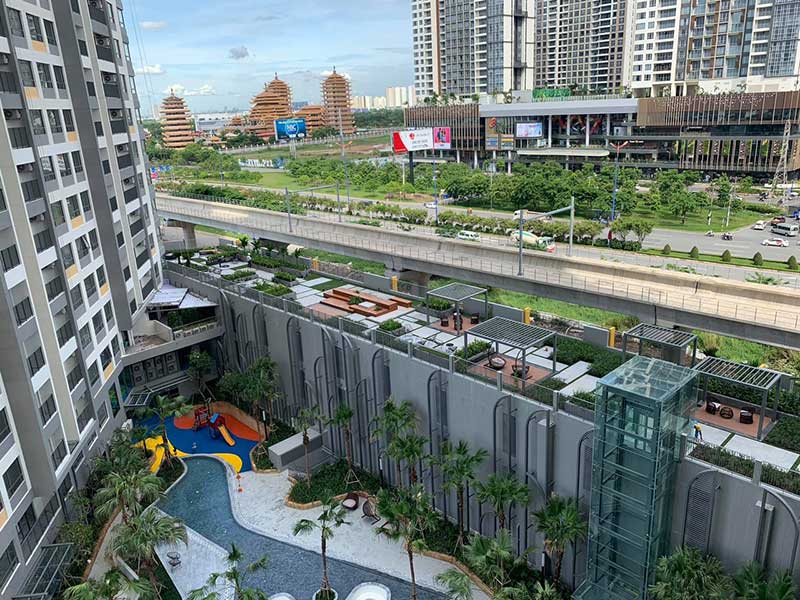
HCMC’s Metro Line 1 opened on 22 December 2024. It runs 19.7 km from Ben Thanh in District 1 to Suoi Tien, with 14 stations: three underground in the centre and 11 on a raised track along Hanoi Highway, now Vo Nguyen Giap Boulevard, past Thao Dien.
Hanoi opened its first line, the raised Line 2A, from Cat Linh, in November 2021. The 8.5 km above-ground section of Line 3, from Nhon to Cau Giay, followed in August 2024, while its underground section to the centre is still being built.
For renters, the practical question is the same in both cities: live close to your office or school, because the metro covers only a few corridors so far.
Work and the job market
HCMC is Vietnam’s largest financial centre and is often called its economic capital. Foreigners there work in IT, manufacturing and engineering, education and services, and many international firms have operations in the city.
Hanoi is the seat of government, with most ministries and embassies in Ba Dinh, alongside a growing services and IT sector. Teaching and IT are common foreign roles in both cities.
The paperwork is the same nationwide: in most cases you need a job offer, a work permit and a degree relevant to the role, whichever city you choose. Our guide to the work permit in Vietnam for renters explains how it affects your lease.
From Visreal’s experience
Since 2017, Visreal has specialised in apartments for foreigners in Ho Chi Minh City, so we see the HCMC side of this decision. We don’t list apartments in Hanoi, but we can tell you honestly what HCMC offers for your budget.
Our process starts with your brief by Zalo, WhatsApp or email: budget, move-in date, office and school. We then build a shortlist and arrange viewings around your schedule, seven days a week.
The tip our agents give most often to people relocating for work: ask for a diplomatic clause in the lease. It lets you end the contract early with 30–60 days’ notice and recover your deposit if your assignment moves you, including back to Hanoi.
After move-in, we stay your contact for repairs, renewals and questions. Gia Hân wrote on Google: “Visreal made my stay in Ho Chi Minh City more pleasant and stress-free. Their staff have always been professional, friendly, attentive, competent, and supportive.” Visreal is rated 4.9/5 from 34 Google reviews.
FAQ
Is Hanoi or Ho Chi Minh City better to live in?
It depends on your priorities. HCMC offers the larger economy, warm weather and a bigger rental market, while Hanoi offers four seasons, a strong sense of history and lower central rents on public data.
Is Hanoi cheaper than Ho Chi Minh City?
For rent in the city centre, usually yes, according to crowd-sourced cost-of-living data. Everyday costs such as food and coffee are very similar in both cities.
Which city has better air quality?
HCMC. IQAir data has shown lower average fine-dust levels in HCMC than in Hanoi, where the cooler months are the worst.
Where do most expats live in Hanoi and in Ho Chi Minh City?
In Hanoi, Tay Ho around West Lake is the main expat area, with Ba Dinh and Cau Giay as alternatives. In HCMC, most expats choose Thao Dien, District 1, Binh Thanh or Thu Thiem.
How much is a 2-bedroom apartment in Ho Chi Minh City?
In Visreal’s listings, 2-bedroom medians range from $950 in District 4 to $1,595 in Thu Thiem, with District 1 at $1,300.
Find your apartment in Ho Chi Minh City
If HCMC is your choice, send your budget, move-in date and office or school by Zalo or WhatsApp on +84 903 004 226; our service is free for tenants. You can also browse all apartments for rent in Ho Chi Minh City to start a shortlist.


